
Last updated September 10, 2026
Full 25-point door and opener safety check with every visit - springs, cables, rollers, tracks, and your LiftMaster or Chamberlain opener included
You get a price before we start. It does not change when the truck arrives.
 Before
 After
After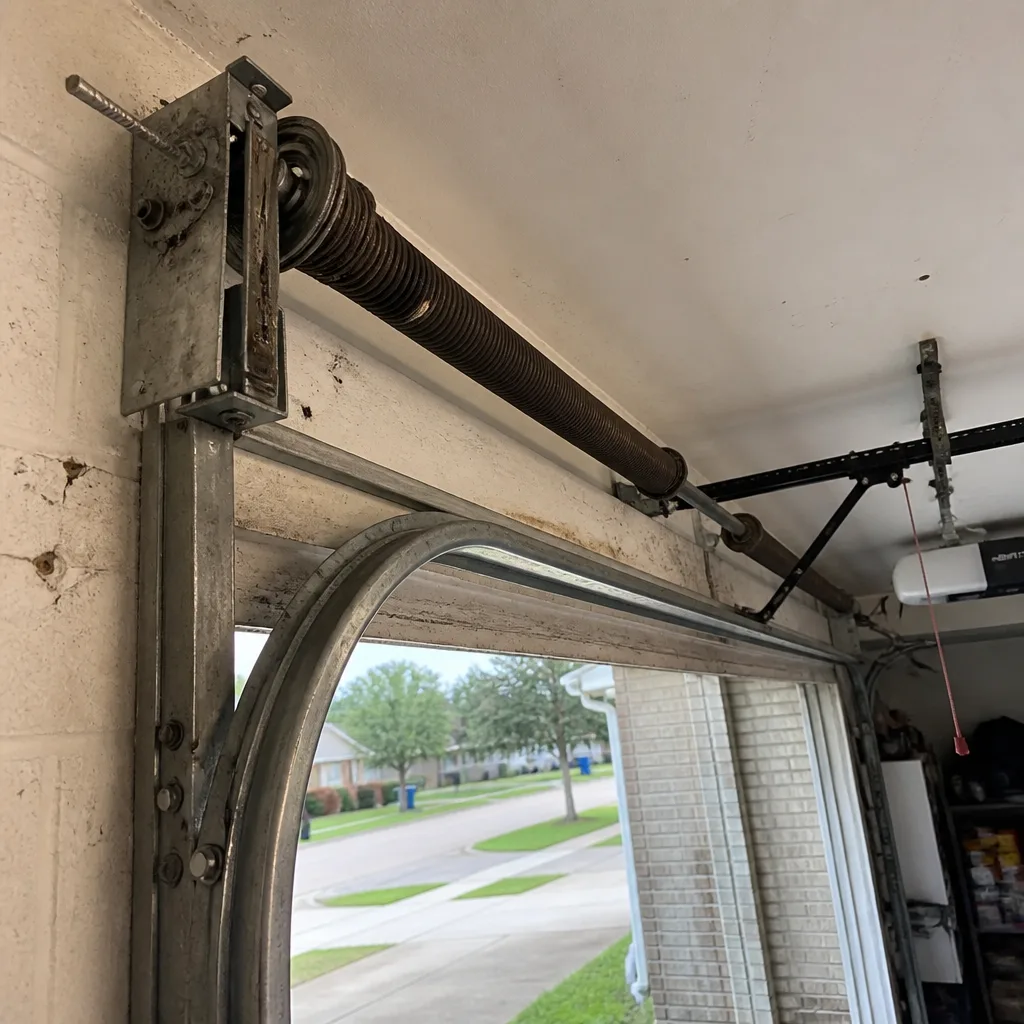 Before
 After
After Before
 After
AfterDIY vs Professional Garage Door: The Katy Homeowner’s Decision Guide
A garage door torsion spring stores roughly 100 foot-pounds of torque - the same energy as a moderate car crash - and releases all of it instantly when something goes wrong. That single fact should anchor every DIY decision a Katy homeowner makes about their garage door. Most online guides blur the line between safe homeowner maintenance and genuinely dangerous repair work, leaving people either falsely confident or unnecessarily cautious. For more guides & resources that draw this line clearly, see our blog. This guide draws that line clearly, task by task, with real costs, real risks, and Katy’s specific climate and market conditions factored in. You’ll know exactly what you can handle yourself, what requires a trained professional, and how to tell the difference before you pick up a wrench.
Quick Answer
Most Katy homeowners can safely handle lubrication, sensor alignment, weather stripping replacement, and basic opener programming themselves. Any work involving torsion springs, cable tension, or door panel structural load should be left to a trained professional - the injury risk is severe and immediate, and the cost savings of DIY rarely exceed $80-120 once tools and time are counted. When stored mechanical energy is involved, the answer is always professional.
Table of Contents
- The One Question That Decides Everything: Stored Mechanical Energy
- What You Can Safely DIY: The Complete Task List
- What You Should Never DIY: High-Risk Repairs Explained
- Real Cost Comparison: DIY Parts vs. Professional Flat Rate in Katy
- How Katy’s Heat and Humidity Change the DIY Calculus
- The Hidden Cost: How DIY Attempts Affect Professional Warranties
- The Tool Reality Check: What You’ll Actually Need
- When to Call a Professional
- Frequently Asked Questions
The One Question That Decides Everything: Stored Mechanical Energy
Before touching any component on your garage door, ask this one question: does this job require releasing stored mechanical energy? If the answer is yes, stop. Call a professional. This criterion separates every safe DIY task from every dangerous one, and it is not negotiable.
Stored mechanical energy in a garage door system lives in two places. First, the torsion springs above the door header, which are wound tight with hundreds of pounds of force to counterbalance a 150-400 pound door. Second, the extension springs along the horizontal tracks, which stretch under load and snap back with lethal force when they fail or are released improperly. Cables under tension, bottom brackets attached to loaded springs, and even some counterweight systems on older doors carry similar risks.
What makes this energy so dangerous is not just the total force - it is the instantaneous release. A winding bar slipping from a torsion spring cone can strike with enough speed to fracture bones or cause head trauma. A broken extension spring can whip across a garage with the force of a snapped cable on a sailboat. These are not gradual, warning-giving failures. They are sudden, violent, and unforgiving.
In our 42 years of service, we have seen the aftermath of well-intentioned DIY spring work more times than we can count. The homeowners were not careless people. They were capable with tools, careful by nature, and often experienced in other home repairs. They simply did not respect the energy stored in that spring until it taught them why they should have. In Katy, where many homes built in the 1990s and 2000s are now seeing original springs reach their cycle limit, this risk is particularly acute.
Jobs that do not involve releasing stored energy - lubricating hinges, aligning safety sensors, replacing weather stripping, programming remotes - carry no comparable risk. A mistake might cost you time or a replacement part. It will not send you to the emergency room. That is the line. Draw it clearly and do not cross it.
What You Can Safely DIY: The Complete Task List
These tasks involve no stored mechanical energy, require no special tools beyond what most Katy homeowners already own, and carry injury risk comparable to standard household maintenance. We have organized them by frequency and skill level.
Monthly: Visual Inspection and Basic Lubrication
- Disconnect the opener by pulling the red emergency release cord (this does not release spring tension - it simply disengages the motor).
- Manually lift the door halfway and release it. A properly balanced door will stay in place. If it falls or shoots upward, the spring tension is off - that is a professional repair, not a DIY adjustment.
- Inspect rollers, hinges, and cables for visible wear, rust, or fraying. Note any issues for a professional call.
- Apply silicone-based lubricant (not WD-40, which attracts dust) to hinges, roller bearings, and the opener chain or screw. Wipe excess.
- Reconnect the opener and test full travel.
This 15-minute routine, done monthly, prevents most premature wear issues in Katy’s dusty, humid environment. See our full Garage Door Repair Maintenance Checklist for Katy Homeowners for a complete schedule. We recommend it to every homeowner who asks what they can do themselves.
As Needed: Safety Sensor Alignment
Photo-eye sensors sit 4-6 inches off the floor on each side of the door track. When a door reverses for no apparent reason or refuses to close, misaligned sensors are the culprit 80% of the time. Clean both lenses with a soft cloth, check that LED indicators on both units glow steady (not blinking), and adjust the wing nuts until they face each other directly. Test by closing the door and waving a broom through the beam - it should reverse immediately.
Seasonal: Weather Stripping Replacement
The vinyl or rubber seal along the door bottom and the stop molding on the sides deteriorates faster in Katy than in drier climates. UV exposure and temperature swings from 40°F winter mornings to 100°F summer afternoons harden the material until it cracks. Replacement is straightforward: measure the width, purchase the correct profile (T-style, bead-style, or bulb-style - bring a photo to the hardware store), slide out the old seal, and press in the new. A hair dryer softens stiff vinyl for easier installation.
Occasional: Opener Remote Programming and Travel Limits
New remotes, keypad codes, and travel limit adjustments are covered in your opener manual. For LiftMaster and Chamberlain units common in Katy homes, the “Learn” button is typically purple, yellow, or red and located near the antenna wire. Press and release to enter programming mode, then press the remote button within 30 seconds. Travel limits adjust with small screws or digital settings on the motor housing - turn in quarter increments and test after each adjustment.
What ties these tasks together: none require touching a component under load. If your hand slips, the worst outcome is a stripped screw or a remote that needs reprogramming. That is the standard for safe DIY garage door work.
What You Should Never DIY: High-Risk Repairs Explained
These repairs all involve stored mechanical energy, structural load, or specialized knowledge that cannot be acquired from a video. The cost savings of attempting them yourself are real but small; the downside risk is permanent injury or death. We do not use that language for effect. We use it because it is accurate.
Torsion Spring Repair and Replacement
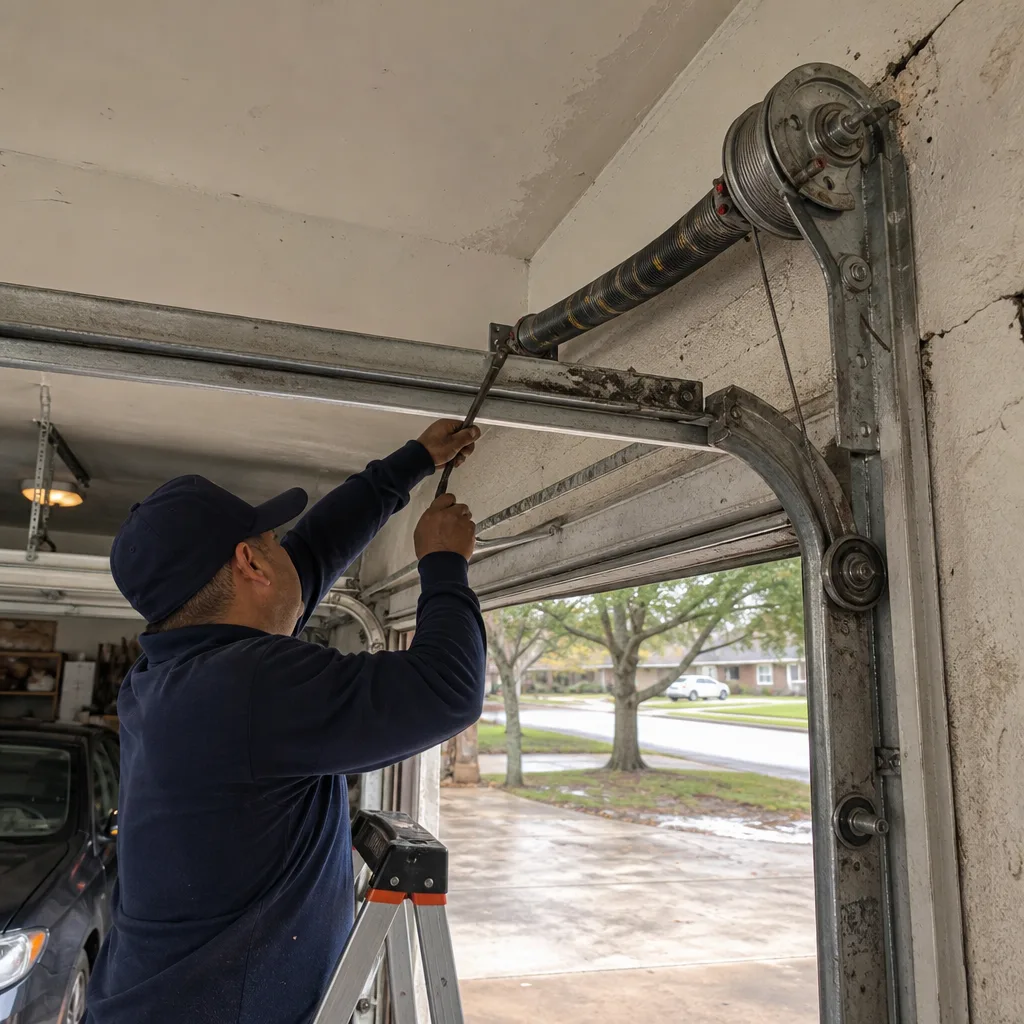
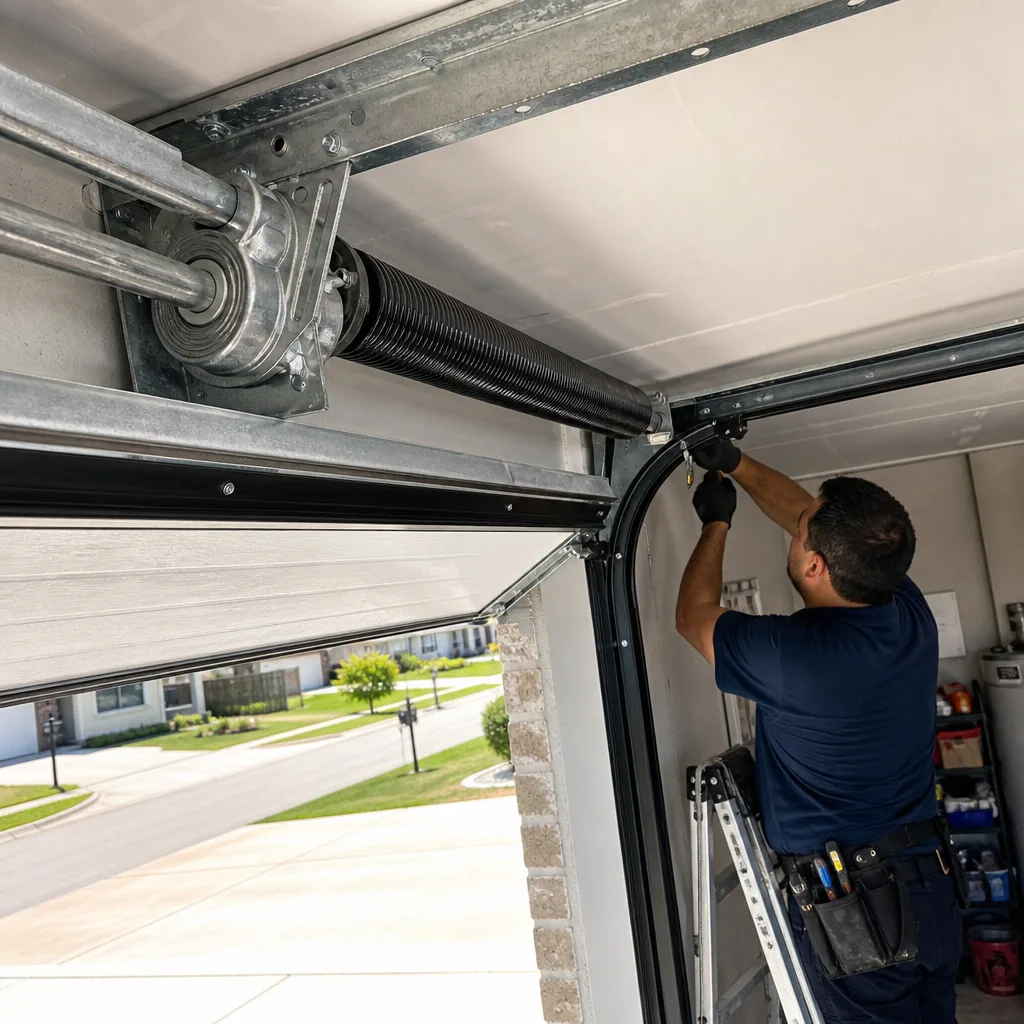
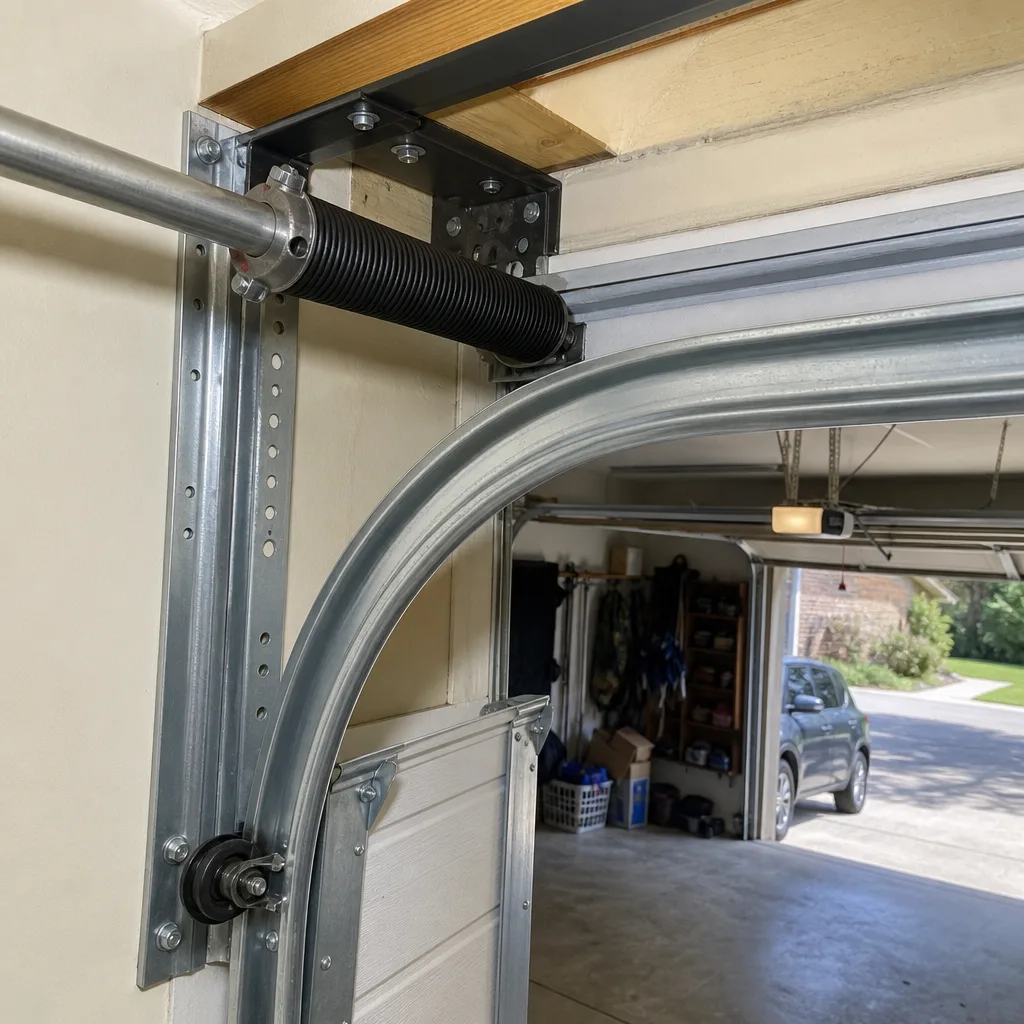
Torsion springs sit on a steel shaft above the door, wound tight with winding cones at each end. To remove or install a spring, you insert solid steel winding bars into the cone and add or release tension in quarter-turn increments. The bars must be the correct diameter (typically 1/2″ or 7/16″), fully seated, and held with both hands at all times. One slip, one bar that is not quite seated, one moment of inattention, and the bar becomes a projectile.
Professional spring replacement in Katy requires not just the winding bars but also a torsion spring calculator (to match wire size, inside diameter, and length to door weight), a vise grip set, and the experience to recognize when a spring is fatigued rather than broken - a distinction that affects whether the second spring should also be replaced. We replace both springs on every call, because a matched pair that has cycled together will fail within months of each other. A homeowner replacing one spring will be back at it - or calling us - before the year is out.
Cable Repair and Tensioning
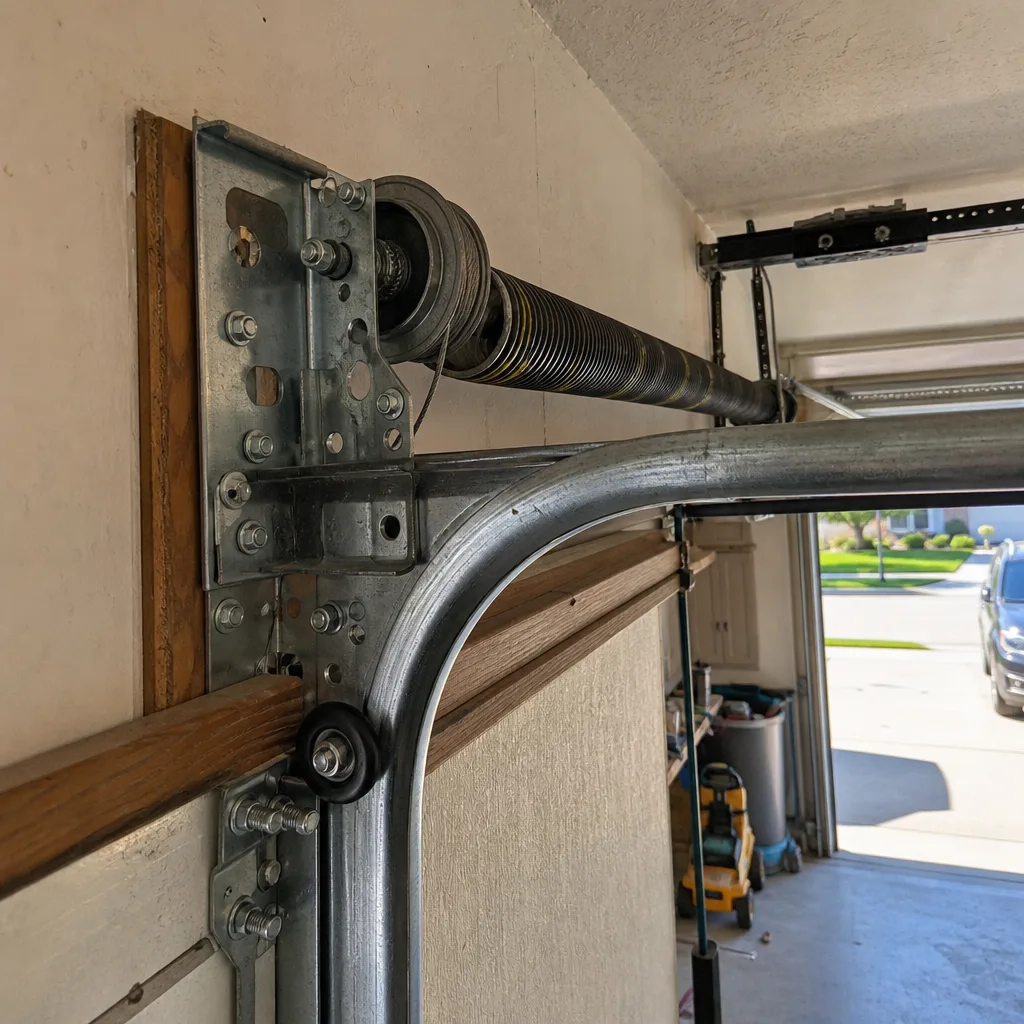
Cables attach to the bottom brackets and run up to the drums at each end of the torsion shaft. When a cable unwinds or frays, it is tempting to think you can simply reattach it. But the cable is under spring tension even when the door is closed, and the bottom bracket is under hundreds of pounds of load. Specialized tools - cable pullers, winding bars, and properly rated clamps - are required to release and reset tension safely. We have seen homeowners who understood the theory but lacked the specific tool for their drum type, and the result was always a call to us after the attempt failed.
Bottom Bracket and Roller Replacement
The bottom brackets on a torsion-spring door are the anchor points for the cable system. They are under constant load from the springs. Removing the bolts to replace a bracket or roller without first securing the door and releasing spring tension causes immediate, uncontrolled door drop. This is not a theoretical risk. In Cinco Ranch and Old Katy, we have responded to doors that crashed down after homeowner bracket replacement attempts, damaging vehicles, storage items, and in one case, the door itself beyond repair.
Structural Panel Replacement
Individual panel replacement on a sectional door seems straightforward: unbolt the damaged panel, slide in the new one. But the hinges between panels are load-bearing connection points, and the door must be supported at the correct height throughout the process. A door that is even slightly misaligned during reassembly will bind in the tracks, strain the opener, and eventually fail. Sectional door geometry is precise to within 1/8 inch. Without proper support jacks and alignment tools, panel replacement distorts the entire door system.
Opener Mounting and Rail Assembly
Opener installation is not primarily dangerous - it is technically demanding in ways that are not obvious. The header bracket above the door must attach to structural framing, not drywall or trim. The rail must be perfectly level. The emergency release must be positioned for actual emergency access. The force and travel limits must be calibrated to the specific door weight and spring condition. An improperly mounted opener works until it doesn’t, and when it fails, it often damages the door or the opener itself. Garage Door Opener in Katy installation is one of our most common correction calls after DIY attempts.
Real Cost Comparison: DIY Parts vs. Professional Flat Rate in Katy
Cost is the primary driver of DIY attempts, and it deserves an honest treatment. Below are the five most common garage door repairs in Katy, with realistic DIY parts costs (sourced from local suppliers and national retailers), professional flat-rate pricing ranges based on our 2024-2025 market data, and honest time estimates for a capable homeowner versus our trained technician.
| Repair | DIY Parts Cost | DIY Time (First Attempt) | Professional Flat Rate (Katy) | Pro Time | Net DIY Savings |
|---|---|---|---|---|---|
| Torsion spring replacement (pair) | $80-140 | 4-6 hours | $220-340 | 45-60 min | $80-220 (before tool cost) |
| Cable replacement (pair) | $25-45 | 3-5 hours | $180-260 | 30-45 min | $135-215 |
| Bottom bracket/roller replacement | $30-60 | 2-4 hours | $160-240 | 30-40 min | $100-180 |
| Weather stripping (bottom + sides) | $35-65 | 1-2 hours | $140-200 | 20-30 min | $75-135 |
| Opener installation (mid-range belt drive) | $280-420 | 5-8 hours | $480-720 | 2-3 hours | $60-240 |
These numbers require three important qualifications. First, DIY parts costs assume you already own the necessary tools. Torsion spring work requires winding bars ($25-40), a vise grip set ($30-50), and often a spring winding tool specific to your cone type. Cable work requires cable pullers ($40-80) and proper clamps. These are single-purpose tools you will likely never use again.
Second, the time estimates assume nothing goes wrong. A first-time spring replacement with a video tutorial typically involves multiple trips to the hardware store, a false start or two, and the learning curve of recognizing when a spring is properly tensioned. We have talked to Katy homeowners who spent an entire Saturday on a repair we completed in under an hour.
Third, and most significant: the DIY savings on high-risk repairs are insurance against injury, not just labor cost. A trip to the ER - even with good insurance - carries deductibles, time off work, and consequences that dwarf any repair bill. We do not say this to frighten. We say it because the calculation is incomplete without it.
For genuinely safe DIY tasks like weather stripping, the savings are real and the risk is minimal. That is where we direct homeowners who want to handle something themselves. For everything else, the flat-rate professional cost includes not just labor but the guarantee that the job is done right, with the right parts, and with our Mainspring Garage Door Co. home 90-Day Done Right Promise behind it.
How Katy’s Heat and Humidity Change the DIY Calculus
Garage door maintenance and repair in Katy is not the same as in Phoenix or Minneapolis. The local climate introduces specific challenges that affect both what fails and how difficult it is to address yourself. Before starting any work, check our guide to Garage Door Permits, Codes & Inspections in TX: What You Need to Know.
Heat and Metal Expansion
From May through September, garage temperatures in Katy routinely exceed 95°F, with metal tracks and hardware expanding measurably. A door that runs smoothly at 70°F may bind at 100°F as steel tracks elongate and roller tolerances tighten. Homeowners attempting track alignment or roller replacement in summer heat face a moving target: the adjustment that seems correct in the morning may be too tight by afternoon. Our technicians account for this by checking door operation across the full temperature range and setting clearances slightly wider than in cooler climates.
Humidity and Corrosion
Katy’s average annual humidity exceeds 75%, and summer months push 90%. This accelerates corrosion on steel components, particularly bottom brackets, cables, and hardware on north-facing doors that stay damp longer. A DIY cable replacement in humid conditions introduces a real risk: the drum and pulley system may have corroded in ways not visible until disassembly, and a homeowner without spare parts on hand faces an incomplete repair and a door that cannot be safely closed. Our trucks carry not just cables but the associated hardware, because we have learned that corrosion rarely limits itself to one component.
UV Degradation of Seals and Exterior Finish
South and west-facing garage doors in Katy receive intense UV exposure that degrades weather stripping in 3-4 years rather than the 7-10 typical in northern climates. The vinyl becomes brittle, cracks, and loses its seal. This is genuinely safe DIY work, but it is more frequent here - a Katy homeowner should plan on weather stripping replacement every 3-5 years, not once per decade.
Storm Season and Wind Load
Katy sits in a high wind zone, and garage doors are the largest structural opening in most homes. After significant weather events, we receive calls from homeowners who attempted to “shore up” a damaged door with plywood or temporary bracing. This is understandable but misguided: a compromised door in a wind event can fail and pressurize the home, causing roof uplift. Proper wind-rated door systems with reinforced struts and specific hardware are code-required in our area for good reason. Temporary repairs after storm damage are not a DIY category - they are an emergency professional service.
In Grand Lakes, Cinco Ranch, and the older neighborhoods near downtown Katy, we see distinct patterns based on home age and orientation. Homes built before 2000 often have original hardware showing accelerated corrosion. Newer construction in Firethorne and Cross Creek Ranch frequently has builder-grade openers and springs at the minimum spec for door weight, meaning earlier failure under our climate stress. These patterns inform what we carry on our trucks and what we check on every service call.
The Hidden Cost: How DIY Attempts Affect Professional Warranties
This is a point almost no homeowner considers until it matters, and almost no DIY guide mentions: attempting a repair yourself can void or complicate professional warranty coverage on that component, even if your attempt was not the cause of the subsequent failure.
Here is how this plays out in practice. A homeowner in Seven Meadows notices a noisy spring and attempts to lubricate it with a generic penetrating oil, not understanding that torsion springs require specific lubricants and that over-lubrication attracts dust that accelerates wear. Six months later, the spring breaks. They call us for replacement. During inspection, we note the residue pattern inconsistent with proper maintenance. The spring manufacturer - and our own 90-Day Done Right Promise - still covers the replacement because we installed it. But if the homeowner had purchased a spring themselves and attempted installation, then called us when it failed, no manufacturer would honor a warranty on a consumer-installed spring. The liability chain is broken.
More significant is the impact on opener warranties. Craftsman, LiftMaster, Chamberlain, and Genie all specify professional installation for full warranty coverage. A homeowner who installs their own opener and later experiences motor failure may find the manufacturer requesting installation documentation. Without a licensed professional’s work order, coverage is reduced or denied.
The same applies to door panel and section warranties from Clopay, Amarr, and Wayne Dalton. These manufacturers warrant their products against material defects when installed according to specification. A DIY panel replacement that results in misalignment - even if the panel itself was defective - complicates warranty claims because the installation cannot be verified.
We are not suggesting manufacturers are looking for reasons to deny claims. We are stating that their warranty systems are designed around documented, professional installation. A homeowner who values long-term protection should factor this into the DIY versus professional decision. The $100-200 saved on a DIY repair can cost significantly more if it voids coverage on a $600 opener or $1,200 door system.
Our standing Garage Door Repair in Katy offer of a Free Second Opinion on any written estimate exists partly for this reason. Before committing to a DIY path that affects warranty status, a homeowner can have our assessment of what is actually needed and what coverage applies.
The Tool Reality Check: What You’ll Actually Need
Every DIY guide should include an honest tool inventory. Here is what the genuinely safe tasks require versus what the dangerous tasks require.
Safe DIY: Tools You Probably Own
- Silicone-based garage door lubricant (not WD-40)
- Soft cloths and mild cleaner for sensor lenses
- Adjustable wrench set
- Phillips and flat-head screwdrivers
- Measuring tape
- Hair dryer or heat gun (for weather stripping installation)
- Step ladder (rated for your weight plus materials)
High-Risk Repairs: Specialized Tools Required
- Solid steel winding bars, correct diameter for your spring cones (hollow pipe or screwdriver substitutes fail catastrophically)
- Torsion spring winding tool or set of graduated bars
- Heavy-duty vise grips (minimum 2, often 4)
- Cable pullers and tensioning clamps
- Door support jacks or locking pliers rated for door weight
- Torque wrench for proper fastener tension
- Spring caliper for wire diameter measurement
The critical point about winding bars: they must be solid steel, precisely the diameter of the winding cone holes, and long enough to provide leverage while keeping hands clear of the spring. We have seen homeowners attempt spring work with adjustable wrenches, pipe segments, or screwdrivers. Each of these substitutes has failed in ways that caused injury. The correct bars cost $25-40. If you are not willing to purchase and use the specific safety tool for this specific job, you should not attempt the job.
For cable and bracket work, the required tools are less dramatic but equally specific. Cable pullers are not standard in homeowner tool collections. Neither are door support jacks capable of safely holding a 200-pound door at working height. The investment in these tools for a one-time repair exceeds the cost difference of professional service.
When to Call a Professional
Call a professional when the job involves stored mechanical energy, structural load-bearing components, or warranty-sensitive equipment. Specifically: torsion or extension spring work of any kind; cable repair, replacement, or tensioning; bottom bracket or roller replacement on a loaded door; panel replacement or structural repair; opener installation or motor replacement; and any repair needed after storm or impact damage.
Also call when you have attempted a repair and something is not right. A door that does not sit level, an opener that strains, a noise that persists - these are signals that the underlying issue was not fully addressed. Continuing to operate a compromised door damages other components and increases eventual repair cost.
In Katy, Mainspring Garage Door Co. offers free estimates with upfront flat pricing. Our technicians arrive with springs, cables, openers, and hardware for all major brands on the truck, so most jobs finish in a single visit. We have served this area since 1984, and we stand behind every job with our 90-Day Done Right Promise in writing. For a square deal from people who will still be here when it matters, call (281) 205-0555.
Common Mistakes to Avoid
- Using WD-40 as garage door lubricant. WD-40 is a solvent and water displacer, not a lubricant. It strips existing grease, attracts dust, and accelerates wear on hinges and rollers. Use silicone-based or lithium-based lubricant formulated specifically for garage doors.
- Ignoring spring age because the door still opens. Torsion springs are rated for 10,000 cycles (roughly 7-10 years of normal use). In Katy’s heat, fatigue accelerates. A spring that is past its cycle limit can fail without warning, and the opener then carries the full door weight until it burns out. Replace springs proactively, not reactively.
- Attempting spring work with incorrect or substitute tools. Adjustable wrenches, pipe segments, and screwdrivers are not winding bars. They slip, deform, or fracture under load. This mistake causes the majority of DIY spring injuries we encounter.
- Replacing only one spring on a two-spring door. Springs on the same shaft cycle together and fatigue together. Replacing one guarantees the other fails within months, often at the least convenient time. Always replace torsion springs as a matched pair.
- Neglecting to check door balance after any hardware work. Even safe DIY tasks like roller replacement can affect door weight distribution. Always test balance by disconnecting the opener and lifting manually. An unbalanced door strains the opener and creates safety risks.
- Assuming all openers install the same way. Chain drive, belt drive, and screw drive units have different rail configurations, header bracket requirements, and force limit settings. A Chamberlain belt drive installs differently than a Genie screw drive. Follow the specific manual, not a generic video.
- Waiting until a minor issue becomes an emergency. A noisy spring becomes a broken spring. A slow opener becomes a burned-out motor. A sticking door becomes a derailed door. Address symptoms early, during regular hours, with a scheduled appointment rather than after-hours emergency rates.
Frequently Asked Questions
Professional repair for common issues in Katy ranges from $140 for weather stripping replacement to $340 for torsion spring replacement, with most repairs falling between $180-280. DIY parts costs are 40-60% lower but do not include specialized tools, your time, or injury risk. For safe tasks like weather stripping, DIY saves $75-135. For spring or cable work, the net savings rarely exceed $80-120 and carry significant physical danger. Call (281) 205-0555 for an exact quote - estimates are free.
You should not replace even one spring yourself. Torsion spring work requires releasing stored energy that can cause severe injury. Additionally, replacing a single spring on a two-spring door is poor practice - the unmatched springs create imbalance and guarantee early failure of the older spring. Professional replacement includes both springs, proper tension matching, and warranty coverage. The flat rate in Katy is $220-340 for the pair.
It can. Manufacturer warranties on openers from LiftMaster, Chamberlain, Genie, and Craftsman require professional installation for full coverage. Door panel warranties from Clopay, Amarr, and Wayne Dalton are contingent on proper installation to specification. A DIY attempt that results in misalignment or improper tension complicates or voids these protections. Professional installation preserves the full warranty chain.
Katy’s 75%+ average humidity accelerates corrosion on steel cables, bottom brackets, and hardware, particularly on north-facing doors and in unventilated garages. Lubricants break down faster in heat. Weather stripping hardens and cracks from UV exposure in 3-4 years rather than 7-10. These factors mean more frequent maintenance, earlier component replacement, and the importance of corrosion-resistant materials. We factor this into every Garage Door Installation in Katy we perform.
Torsion spring replacement is the most dangerous. A standard spring stores approximately 100 foot-pounds of torque, released instantaneously if a winding bar slips or a cone fractures. The resulting projectile can cause head trauma, broken bones, or lacerations. Extension springs are similarly dangerous when they snap. No cost savings justify this risk. This is the repair we most strongly recommend leaving to trained professionals with proper tools and insurance.
A door that will not close and lock is a security emergency. A door stuck open with vehicles inside is a functional emergency. A broken spring with the door open is dangerous - the door can fall if support fails. A door that makes loud grinding noises or has visibly frayed cables is an imminent failure risk. Mainspring Garage Door Co. answers calls live 24/7, including nights, weekends, and holidays, and we prioritize genuine emergencies for same-day response. Call (281) 205-0555 if you are unsure - we will tell you honestly whether it can wait.
The Bottom Line
The DIY versus professional question for garage doors is not about your skill with tools. It is about whether a specific task involves stored mechanical energy that can injure or kill you when released. Lubrication, sensor alignment, weather stripping, and remote programming are genuinely safe for capable homeowners and offer real savings. Spring work, cable tensioning, structural repairs, and opener installation are not - the risk is immediate and severe, the tool investment is significant, and the warranty implications are lasting. In Katy’s demanding climate, proper materials and installation technique matter even more. When the job crosses the energy line, call a professional who carries the right parts, states the price upfront, and stands behind the work. That is the square deal, and it is worth more than any DIY savings.
Written by Carl Dutton, Owner at Mainspring Garage Door Co., serving Katy since 2016.